
Driving Regional Prosperity
Kākāriki’s Detailed Submission on the New Zealand Geothermal Strategy
In September 2025, Kākāriki Renewables provided a comprehensive response to the Ministry of Business, Innovation and Employment (MBIE) regarding the draft strategy, From the Ground Up. This submission outlines a vision where geothermal energy serves as the foundation for a "600% Renewables" goal—a target Kākāriki believes is achievable and essential for New Zealand's economic future.Kākāriki’s core philosophy is "Regions Rising." We believe that geothermal development must move beyond simple grid-connected power generation and instead focus on creating vibrant regional ecosystems.

Simon Currie
Co-Founder & Executive Chairman
#1 Are the three strategic outcomes of the strategy suitable, or is there more we need to consider?
We generally agree with the three strategic outcomes—world-leading innovation, energy resilience, and regional/Māori economies—as they align with our own vision.
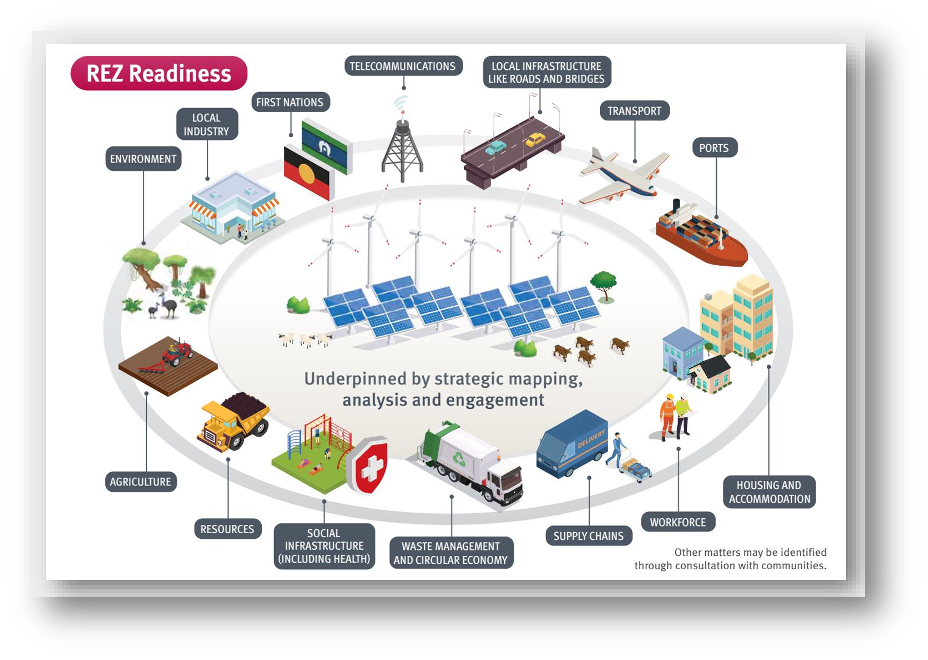
However, we believe it is important to highlight the need to invest in enabling infrastructure in these regions to fully capture these benefits. Without it, there is a risk that investment will only result in more grid-connected projects that do not adequately contribute to host regions and te Ōhanga Māori. We advocate for "systems thinking" in the development of Renewable Energy Zones (REZ), similar to the successful models used in Queensland, Australia.
The lessons from Queensland and development of their renewable zones is usefu. The infographic (REZ readiness) was produced after extensive consultation as to what REZ Readiness means in practice and we believe it is great example of the systems thinking required in order to harness renewable resources in a manner which delivers a vibrant and enduring ecosystem.
#2 Do the 5 overarching action plan goals capture the areas that are most important for achieving the vision?
We agree with the five action plan goals identified but provided specific recommendations on two critical fronts:
Improving Access to Data: Currently, the geothermal market is dominated by a few major "gentailers". To incentivize new investment and competition, we recommend that license holders be required to make specific development data publicly available to help prevent the "land-banking" of resources.
Crown-Led Exploration: We welcome the proposal for government-led exploration, as seen in frontier markets like Kenya, where the government proves up resources to spur investment and facilitate partnerships with iwi groups.
Enabling Place-Based Clusters: We believe this is an immediate opportunity for regions like Taupō, Kawerau, and Ngāwhā. If the strategy only unlocks new grid-connected capacity, we believe it represents a failure to capture the true opportunity for regional growth.
Northland (Ngāwhā):
The Ngāwhā resource has been tapped for the existing power station which feeds into the electricity transmission system. The resource is located next to the Ngawha Industrial & Enterprise Park. Existing regional industries which can be supported include AFFCO’s Moerewa plant and new railway line to the region.
Kākāriki has been long term proponents of a Northland Renewable Energy Zone and investment in enabling infrastructure – please see Energy Estate/Elemental Group submission to the Transpower 2022 REZ consultation - https://www.transpower.co.nz/renewable-energy-zones-consultation-responses-2022.
We strongly support the development of new transmission infrastructure in Northland and welcomed the funding to explore for the proposed Energy Bridge. https://www.beehive.govt.nz/release/government-exploring-northern-%E2%80%98energy-bridge%E2%80%99
New transmission infrastructure can unlock the next stages of the Ngawha geothermal resource and attract new industries to the region such as renewable fuels and food production and processing (which can utilise the CO2 produced from harnessing additional geothermal resources).
For Kākāriki this is part of a broader focus on the Te-Matai-E Te Tokerau REZ and unleashing the potential of the Northland region.
Taupo:
Unlocking additional geothermal capacity in the Taupo/Wairakei region can support growth of the local forest products sector and build upon new industries such as renewable fuels. The recently announced invested by Meridian Energy and Nova Energy into the large-scale solar farm at Tahui is a very positive step for the region.
This region benefits from access to robust transmission infrastructure and harnessing additional geothermal capacity can help protect consumers from the issues facing the Waikato River hydro system such as changing inflows and downstream environmental constraints. To date the Taupo/Wairakei geothermal capacity has generally been used to power the Upper North Island rather than drive regional economic growth.
We believe that a place-based cluster can drive investment into industries such as vertical farming, sustainable building materials and a transport and logistics hub. We also believe that this region can play an enhanced role in industrial tourism and training and would be a good location for the Geothermal Centre of Excellence and a world class education and training center.
We believe that development of additional large scale wind energy and battery energy storage sites in the immediate region can complement the existing hydro and geothermal capacity and new geothermal and solar capacity and help to create a regional superhub which leverages off the existing investment in geothermal, hydro and electricity transmission infrastructure.
Kawerau:
Unlocking additional geothermal capacity in the Taupo/Wairakei region can support growth of the local forest products sector and build upon new industries such as renewable fuels. The recently announced invested by Meridian Energy and Nova Energy into the large-scale solar farm at Tahui is a very positive step for the region.
This region benefits from access to robust transmission infrastructure and harnessing additional geothermal capacity can help protect consumers from the issues facing the Waikato River hydro system such as changing inflows and downstream environmental constraints. To date the Taupo/Wairakei geothermal capacity has generally been used to power the Upper North Island rather than drive regional economic growth.
We believe that a place-based cluster can drive investment into industries such as vertical farming, sustainable building materials and a transport and logistics hub. We also believe that this region can play an enhanced role in industrial tourism and training and would be a good location for the Geothermal Centre of Excellence and a world class education and training center.
We believe that development of additional large scale wind energy and battery energy storage sites in the immediate region can complement the existing hydro and geothermal capacity and new geothermal and solar capacity and help to create a regional superhub which leverages off the existing investment in geothermal, hydro and electricity transmission infrastructure.
#3 Subsidies for renewables could be removed by governments in the future
NO – renewable energy in New Zealand is completely unsubsidised and never has been. Wind, solar and batteries have to compete head-to-head with other forms of electricity generations such as geothermal, hydro, coal and gas. So, there is no risk that a future government can remove subsidies.
The current government has introduced reforms to the consenting regime to accelerate the pathway for renewable energy and infrastructure generally. This is all about reducing barriers to investment rather than introducing subsidies.
#4 Does the proposed action plan correctly capture the necessary government interventions and priorities?
We believe the Government can play a much more active role going forward than it has historically. While New Zealand has a world-class track record in geothermal energy, it hasn't always been fully promoted by the Government. We recommend:
Increased cooperation with other countries with geothermal resources regarding supply chains, investment, and financing.
A long-term plan for ongoing engagement with industry to support a 10–15 year pipeline of opportunities.
#5 Is the role for the sector clear? How can the wider geothermal sector play a role?
We note that while there is already a reasonable level of collaboration within the industry, our collective ambition levels need to grow. We believe the sector should focus on:
Delivering place-based outcomes for regional economies, particularly as natural gas resources in New Zealand decline.
Working with the government to build a clear, addressable pipeline of opportunities for the next decade to avoid a "stop-start" approach.
#6 Does the strategy create the right settings to enable tāngata whenua to realise their aspirations?
We are committed to partnerships with tāngata whenua for all of our projects, defined by co-design, co-governance, and co-ownership. While the geothermal sector has led the way in these partnerships, we believe a key issue to solve is ensuring that funding mechanisms are in place to allow iwi to turn options into long-term ownership. We believe the increasing levels of First Nations ownership in Canada should be considered as a reference.
#7 Are there opportunities for our geothermal sector that we haven’t considered?
We would like to highlight several high-growth opportunities:
Digital Infrastructure: Geothermal clusters can attract data centers and other energy-intensive industries. We are currently developing new subsea data cables from California with landing points on the east coast of New Zealand to anchor this opportunity.
Sustainable Manufacturing: We are passionate believers in New Zealand becoming a world leader in manufacturing sustainable building materials by locating hubs near existing forest products and fiber resources.
Green Fuels: We believe regions like Kawerau, with access to biomass and geothermal CO2, can underpin large-scale green methanol production plants.
#8 Are there any challenges for our geothermal sector that we haven’t considered?
We identify two primary challenges:
Workforce Capacity: The sector faces a retiring workforce, requiring urgent capacity building and transition plans—a challenge shared with the hydropower sector.
Access to Capital: Achieving the full potential of the sector will require new sources of capital, as the balance sheets of existing gentailers and transmission companies are already heavily committed to other renewable investments.
#9 Are there any other things that the strategy should include or exclude?
We want to emphasize that geothermal can "crowd in" investment for the entire energy sector. New Zealand’s combination of geothermal, wind, and solar resources is a globally attractive opportunity. Because our gas reserves are declining, investment in geothermal is an essential step forward that doesn't have to compete with historic fossil fuel investments.